Choosing an integration layer is a significant commitment that’s notoriously difficult to walk back. If you pick a platform that doesn’t scale or locks your data into a proprietary black box, you’re stuck with it — along with the burden of mounting costs and technical debt.
For enterprise IT teams, the goal isn’t to chase a tool with the right logos on its integrations page. You need a deployment model that aligns with your security requirements and gives you enough visibility to troubleshoot when things break.
This article compares several cloud integration platforms to help you evaluate the architecture that best supports your stack without creating a permanent vendor lock-in.
What a cloud integration platform actually does
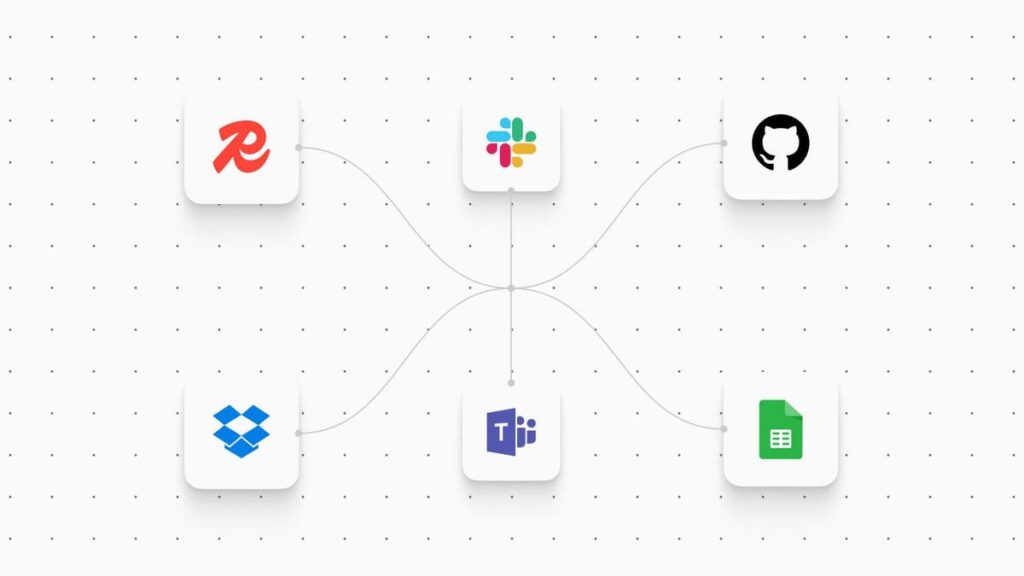
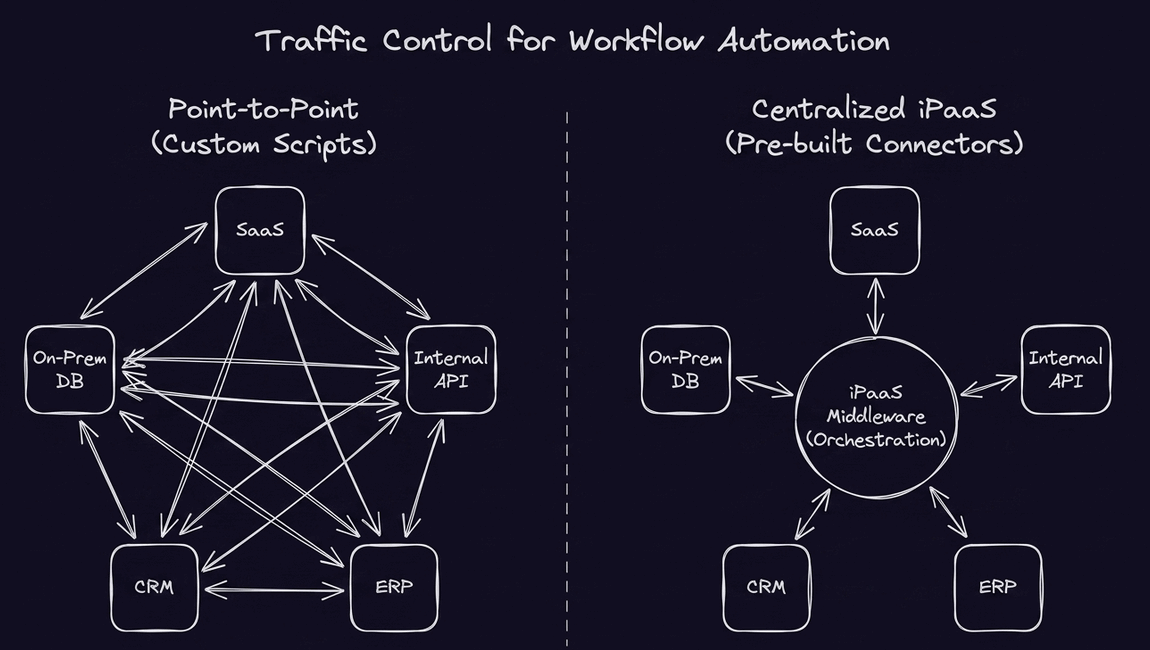
An iPaaS — a cloud integration platform — is the middleware that keeps data from fragmenting. It handles the synchronization and real-time data transfer that your core applications weren’t built to manage on their own. Basic API connectors only move a payload from point A to point B, but integration platforms go further. They orchestrate logic and transfer protocols to maintain the data pipeline between SaaS apps, on-prem databases, and internal microservices.
This layer functions as air traffic control for your workflow automation. By centralizing API connectivity through pre-built connectors instead of writing scripts for every new tool, you create a repeatable way to manage application integration.
What to look for in a cloud integration platform
To help differentiate self-hosted and iPaaS platforms at an architectural level, look past the UI and evaluate how the deployment model affects data flow and compliance requirements.
Scroll for more →
| MANAGED SAAS IPAAS | HYBRID IPAAS | SELF-HOSTED | |
|---|---|---|---|
| Connector depth | Optimized for common SaaS-to-SaaS triggers but becomes limited when custom API logic is required | It uses standardized agents to bridge cloud and local systems | It combines native nodes with the ability to write custom code for any endpoint |
| Deployment model | Vendor hosts infrastructure, data processing, and control plane | Vendor hosts control plane, but data processing happens on local agents | Entire stack resides on your infrastructure, ensuring full data sovereignty |
| Scalability | Scaling is automatic, but often tied to per-task pricing tiers | Scaling requires adding more local agent instances to your environment | Scaling via an orchestration tool (like Docker or Kubernetes) based on actual resource consumption |
| Extensibility | Usually restricted to a visual DSL or limited lambda functions for custom logic | It’s limited by what the vendor’s local agent is permitted to execute | It allows you to run native support (i.e. with JavaScript/Python) and custom environments |
| Governance | You rely on the provider’s security certifications and RBAC models | Security is split between the vendor’s cloud and your local network security | You can add your own RBAC, SSO, and auditing logs within your perimeter |
The best cloud integration platforms
The market for cloud integration tools is crowded, ranging from lightweight automation builders to heavy-duty enterprise service buses. Choosing the right enterprise integration platform requires evaluating your company’s data flows first and whether you are dealing with sensitive data. This will give the general understanding of the key features a suitable iPaaS must support.
The following summary table provides a quick orientation of eight top platforms:
Scroll for more →
| PLATFORM | KEY FEATURE | BEST FOR | PRICING MODEL |
|---|---|---|---|
| n8n | Source-available and self-hosting for full data control | Engineering-led teams needing high customization and AI workflows | Usage-based; Business / Enterprise tiers |
| MuleSoft | Comprehensive lifecycle management for complex enterprise ecosystems | Global enterprises managing legacy-to-cloud transitions | Annual contract |
| SnapLogic | AI-powered visual components for complex data mapping | Organizations automating high-volume data flows without deep coding | Subscription-based |
| IBM App Connect | Deep integration with IBM middleware and legacy messaging | Highly regulated industries within the IBM ecosystem | Tiered enterprise |
| Boomi | Distributed architecture executing integrations locally or in the cloud | Data-heavy enterprises building a multi-cloud single source of truth | Connection-based |
| Informatica | Sophisticated AI for metadata management and data quality | Data-heavy enterprises building a multi-cloud single source of truth | Consumption-based |
| TIBCO Cloud | High-performance messaging for real-time asynchronous data | Finance and logistics firms requiring ultra-low latency | Tiered enterprise |
| Workato | Accessible low-code interface for cross-departmental workflows | Rapid scaling of business-led automations under IT governance | Monthly step-based contracts |
n8n
n8n is a source-available AI-native automation platform for technical teams. It offers many features typically associated with iPaaS solutions and provides a unique blend of visual workflow design with coding flexibility.
- Technical capability: n8n’s core strength is the HTTP Request node (in addition to hundreds of pre-built connectors) combined with native code support. When a native integration hits a limit, you can write JavaScript to handle the edge case or connect to virtually any service with the configurable HTTP Request node. Because you can self-host n8n, you get full control over your SaaS integration flows and can manage everything behind your own RBAC and SSO.
- Best for: Engineers and IT managers building high-complexity AI workflows who won’t settle for the limitations of a closed-box SaaS vendor.

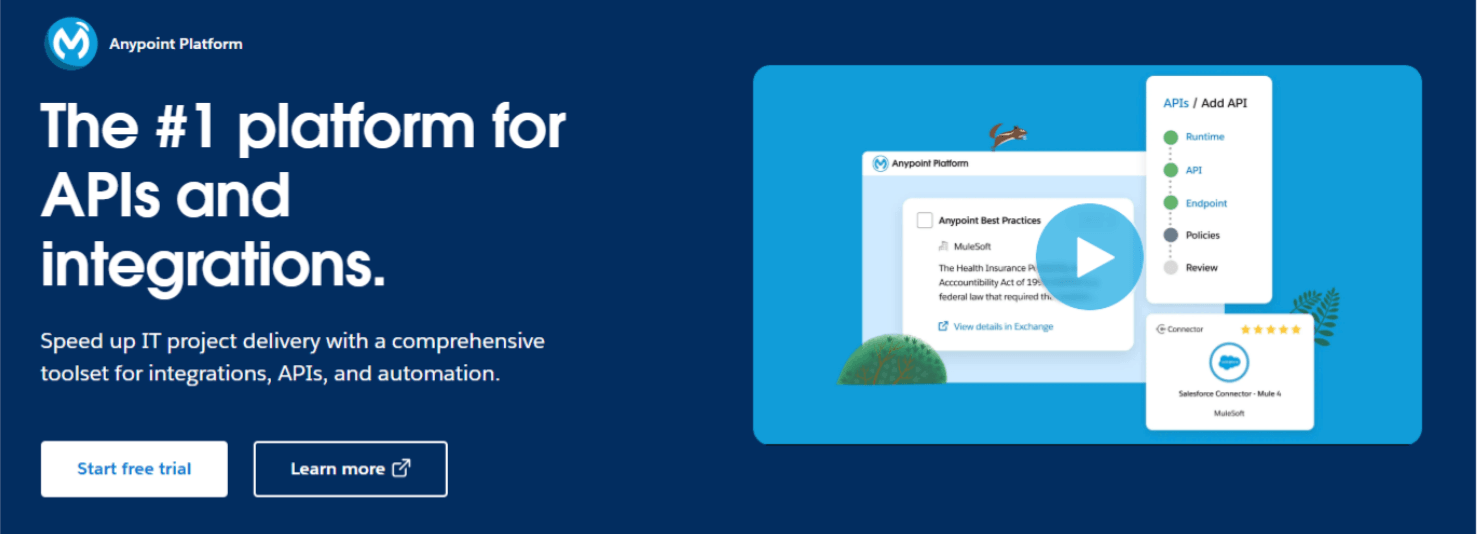
MuleSoft Anypoint
MuleSoft Anypoint is the enterprise standard for organizations that need to bridge modern SaaS apps with massive legacy systems. It also offers a full lifecycle API management suite.
- Technical capability: MuleSoft uses a “Java-under-the-hood” approach with its own expression language (DataWeave). It lets you create a reusable API-led connectivity layer for large-scale digital transformation projects.
- Best for: Companies with heavy technical debt and the budget to support a dedicated MuleSoft team.
SnapLogic
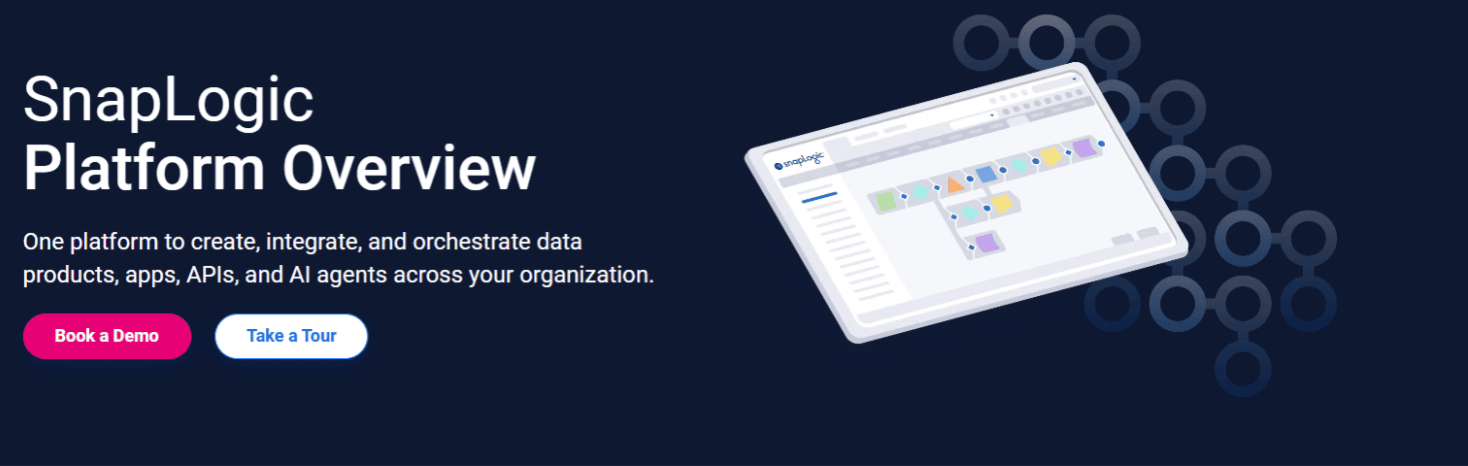
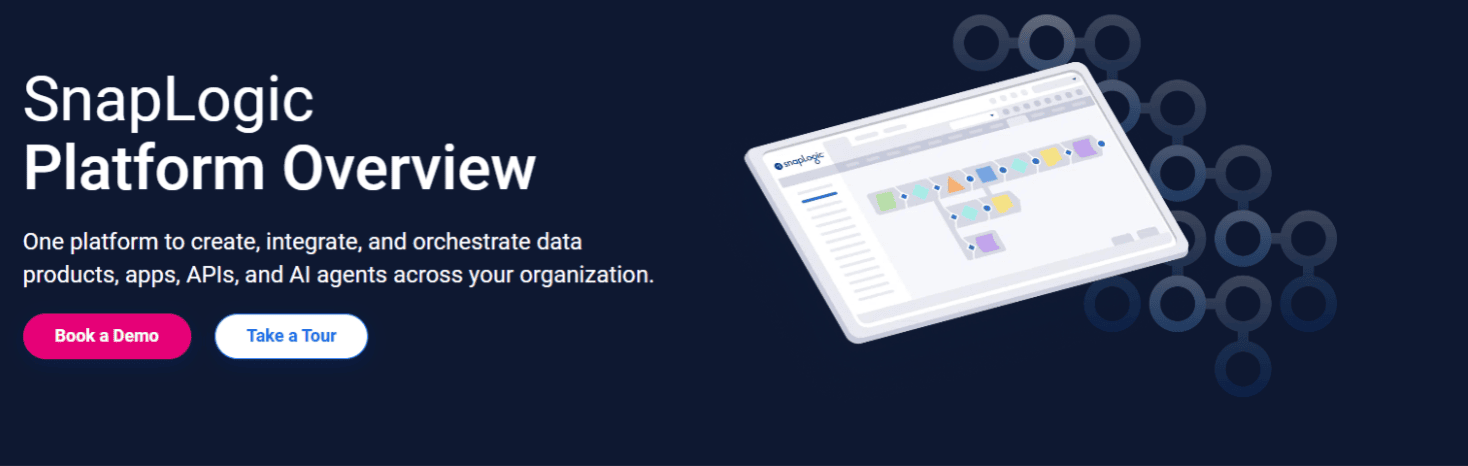
SnapLogic is built around the concept of “Snaps” — modular, visual connectors that handle complex data transformations without requiring heavy boilerplate code.
- Technical capability: Its AI-driven integration assistant (Iris) uses machine learning to suggest the next step in a data pipeline. SnapLogic is particularly strong at handling the high-volume data flows required for cloud data warehousing.
- Best for: Large organizations that need to automate data movement at scale but want a more visual, low-code experience than MuleSoft.
IBM App Connect
IBM App Connect sits within the IBM Cloud Pak for Integration. It’s built for teams who live in the IBM ecosystem and have strict requirements for application integration and security.
- Technical capability: It offers deep support for various deployment models, including managed SaaS and self-hosted instances on Red Hat OpenShift. It’s built to handle complex enterprise messaging protocols like MQ alongside modern REST APIs.
- Best for: Highly regulated sectors like banking and insurance that need enterprise-grade governance and hybrid cloud flexibility.
Boomi
Boomi (formerly Dell Boomi) was one of the first players to move the enterprise service bus concept into the cloud. It’s a mature platform that focuses on making hybrid deployments manageable.
- Technical capability: The platform features a lightweight runtime engine (originally called “Atom”). You manage integrations in Boomi’s cloud, but execution happens on runtime engines (basic or cluster) deployed in your VPC or on-premises server. This allows for seamless cloud-to-cloud integration while keeping sensitive data behind your firewall.
- Best for: Mid-market to large enterprises that need a proven, stable bridge between their modern SaaS apps and legacy on-premise databases.
Informatica Intelligent Data Management Cloud
Informatica focuses on the data side of cloud-to-cloud integration rather than simple app-to-app triggers.
- Technical capability: Informatica excels at high-volume ETL/ELT processes and metadata management. Its primary differentiator is the data synchronization and quality governance it provides across multi-cloud environments. Its AI engine (CLAIRE) automates data discovery and mapping, which saves significant time for large-scale data pipeline projects.
- Best for: Data-heavy organizations that prioritize building a single source of truth and maintaining strict data governance across multiple clouds.

TIBCO Platform
TIBCO Platform specializes in high-throughput, real-time messaging. It’s built for environments where low latency and reliable message delivery are important .
- Technical capability: A unified TIBCO Platform is an evolution of the fragmented TIBCO Cloud products. It’s built for event-driven orchestration and handles massive event streams using messaging protocols — like JMS or MQTT — that go beyond standard REST/JSON limitations. The platform provides a resilient middleware layer that supports high-frequency data flows, such as real-time inventory updates or financial transaction processing.
- Best for: High-stakes sectors like logistics and finance that require low-latency, asynchronous messaging across global infrastructures.
Workato
Workato is a cloud-native platform that targets workflow automation across business units. It’s designed to be accessible to technical teams and power users while maintaining IT-governed security standards.
- Technical capability: Workato uses a “recipe” model for integration logic. The interface is visual and supports complex conditional logic while providing enterprise features like RBAC and automated error handling. It’s optimized for SaaS integration where the goal is to sync data across systems like Salesforce, ServiceNow, and internal APIs.
- Best for: Companies that need to scale their integration count quickly and want to empower departmental teams to manage their own workflows under IT-defined guardrails.
Building for the AI-driven stack
As organizations move toward autonomous operations, your application integration platform has to do more than move data. It needs to orchestrate intelligence in several new ways:
- First, it should support user-heavy interfaces like ChatGPT and Claude Cowork. A common way of doing this is via MCP connectors;
- Next, when an integration breaks or requires an update, an AI agent should have an ability to diagnose an error and fix it by editing the integration workflow. This can be done by exposing SDK or an MCP to a coding agent that can work on its own and ask for user confirmation on critical steps;
- Finally, fully (or almost fully) autonomous AI workflows require a multi-step reasoning engine that allows agents to complete complex tasks using available tools.
In n8n, all three patterns are supported out of the box, even on the Community edition.
Futureproof your enterprise stack with n8n
Choosing a cloud integration platform is an infrastructure commitment that dictates how your data will flow for years to come. Swapping these tools later is expensive, so the priority should be a model that provides long-term visibility and control.