
Modern systems don’t operate in isolation. They’re networks of specialized elements working together to produce the applications users see. When those services interact synchronously, a slowdown in one component can affect the entire system.
Event-driven microservice architecture shifts coordination from tightly coupled requests to asynchronous event flows. This model allows services to operate independently, respond in real time, and scale without the brittleness of cascading, synchronous dependencies.
What are event-driven microservices, and how do they work?
Microservices architecture breaks applications into smaller services, each responsible for a single function. They improve scalability, but they still need to communicate through APIs. Service_1 calls Service_2 and waits for a response, and so on.
Event-based microservices take a different approach. Instead of making API calls, services communicate by publishing messages to a broker, which routes them where they need to go.
Event-driven architecture (EDA) has three major components:
- Event producers: Emit events when something significant happens, such as an item added to a shopping cart or a payment is approved.
- Event consumers: Subscribe to messages and handle events with the appropriate business logic.
- Event brokers: Receive events and hold them until a consumer is ready to receive them.
💡
It’s helpful to think of this relationship as follows: microservices define service boundaries, while event-driven architecture defines the communication style. These patterns solve different problems and can complement each other: “event-driven microservices” architecture simply combines both approaches into a hybrid model.
Event-driven vs. request-driven architecture
The key difference between these two models is how systems coordinate work:
- Request-driven model: Services call each other and wait for a response. This is simple and works well for real-time actions, but it also means one slow or failing service can delay everything downstream.
- Event-driven model: Services announce events and continue processing. This improves resilience and scalability, but it shifts responsibility to handling, timing, retries, and message order explicitly.
In a microservices architecture, synchronous APIs remain essential for user interactions that need immediate feedback — like authentication, checkout, or payment authorization — while asynchronous events handle downstream work such as updating analytics, invoicing, or notifying other systems.
If you try to force these into async flows, you risk inconsistent data and poor user experience. Instead, modern systems often use a hybrid approach where synchronous APIs handle real-time requests and asynchronous events orchestrate cross-service workflows behind the scenes.
Benefits and tradeoffs of event-driven microservices
Implementing event-driven microservices can provide many advantages along with potential challenges.
Benefits
Here’s where event-driven microservices provide the most value:
- Scalability: Services scale based on their own workload rather than the needs of upstream services. For example, you can spin up more order-processing workers during a spike without affecting payment services.
- Resilience: Failures are contained within individual services, allowing others to continue processing events. This reduces the risk of large-scale failures.
- Faster development and deployment: Software engineering teams can build and release services independently without waiting for changes in tightly coupled systems, which reduces coordination overhead.
- Reduced costs: Services can be more precisely scaled, which helps reduce overprovisioning and infrastructure costs, especially under uneven workloads.
Tradeoffs
Event-driven systems introduce new responsibilities. The following tradeoffs show where this model can create friction or overhead:
- Eventual consistency: Data isn’t updated instantly across all services. Teams need to design for this delay and ensure the system eventually converges to a consistent state. If your use case can’t tolerate this delay, this model can introduce risk.
- Observability difficulty: It can be harder to trace how an event moves through multiple services compared to a call-response flow. Without specialized tooling, understanding system behavior becomes a significant challenge.
- Debugging complexity: When something goes wrong in an async chain, identifying the root cause takes more effort, especially without centralized tracing. Tracing the flow of events often requires correlating logs, IDs, and timestamps across systems.
- Infrastructure overhead: Event-driven systems require additional components like message brokers, schema management, and monitoring tools, which increases operational burden if the system is small.
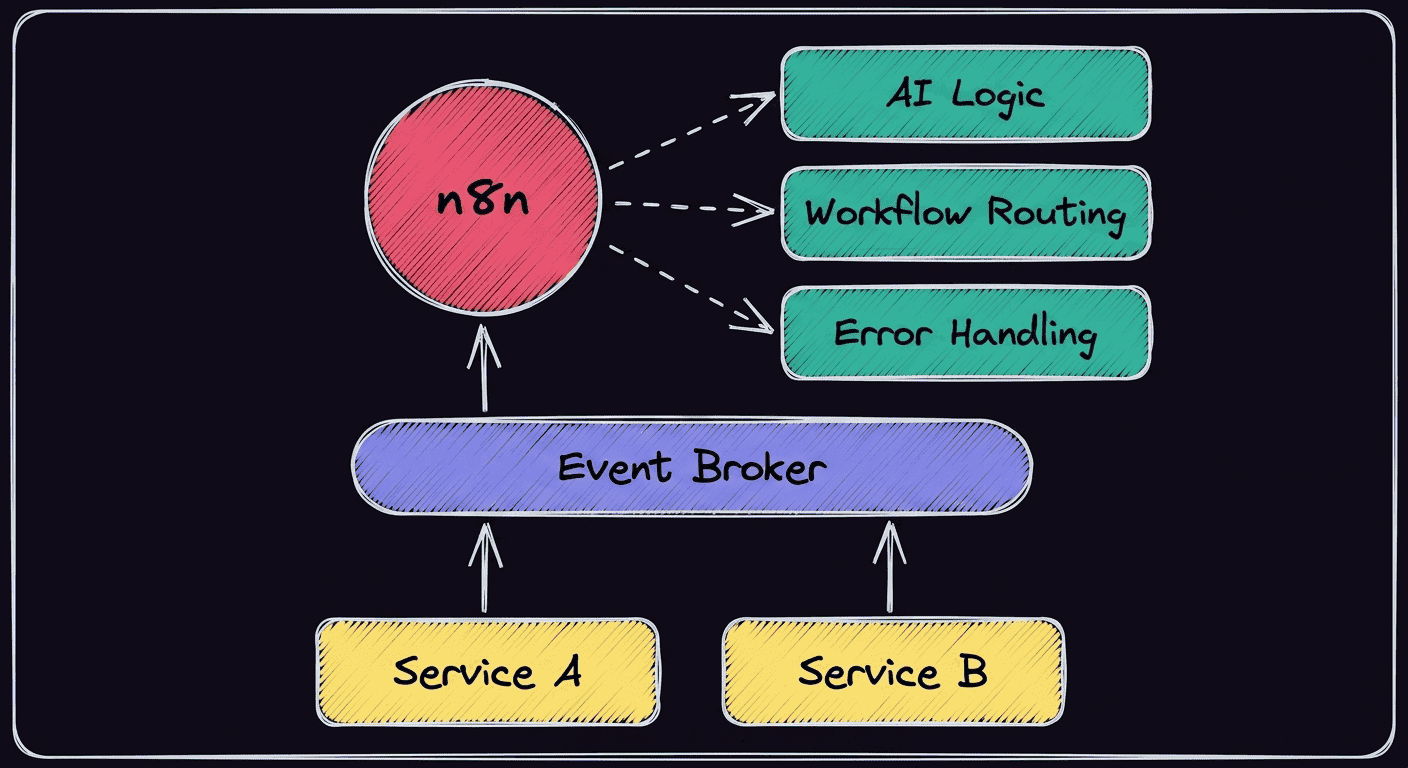
Event-driven systems require strong observability to remain manageable in production. While n8n isn’t a microservice framework itself, it’s a practical companion for event-driven microservice.
It orchestrates cross-service workflows, hosts AI-powered decision logic, and gives teams a unified view of event executions across systems:
- n8n sits one layer above as a workflow orchestrator: it listens to events via trigger nodes, runs multi-step workflows, and records every execution. This makes it easier to trace how an event moved through external APIs, internal services, and AI components without building custom tooling for each integration.
- For teams experimenting with AI-powered automations, n8n’s LangChain nodes turn event payloads and business rules into LLM-powered workflows that can call APIs, transform data, and make routing decisions. Instead of wiring agents directly into your microservices, you can keep AI logic in n8n, where execution history, error handling, and retries are built in — then apply these AI workflow builder best practices to keep those flows reliable and maintainable from the start.
- When you need to connect event-driven microservices with external systems or trigger workflows from APIs, the HTTP Request node acts as a flexible entry point and integration surface. Combined with webhook triggers and other event sources, it lets n8n receive, send, and inspect event data across services, so you can build orchestration around your microservices without changing how they are deployed or scaled.
Choosing your messaging framework
The choice of a messaging framework is one of the most consequential infrastructure decisions in an event-driven system. You must consider how events are delivered, how long they are retained, whether they can be replayed, and how complex the system is to operate. Choosing the wrong model can either limit scalability or introduce unnecessary complexity.
Scroll for more ➔
Message queues are well-suited for standard workflows where each message is processed only once. Event streams are necessary if you need to replay historical data or allow multiple independent servers to process the same event.
n8n integrates with both models. It offers native support for RabbitMQ and Kafka, supports AWS SQS, and can connect to other brokers via HTTP or community nodes. This allows teams to consume events, generate new ones, and orchestrate downstream workflows visually. As workflows become more complex, teams can also explore AI agent orchestration frameworks to manage multi-step, decision-driven automation across services.
Event-driven anti-patterns to avoid in production
Avoid these common pitfalls in designing your event-driven architecture:
- Too many fine-grained events: Publishing events with too much detail creates unnecessary noise and forces consumers to reconstruct state unnecessarily.
- Generic or ambiguous event names: Events with poorly chosen names don’t clearly communicate what happened, forcing consumers to inspect payloads before acting. Use descriptive business-meaningful names so intent is clear without inspecting payloads.
- Complex dependency graphs: When events trigger chains that loop back on themselves, systems become difficult to reason about and may act unpredictably. Be cautious with looping patterns in workflows to avoid hidden recursion and execution overhead. Keep event flows simple and acyclic.
- Synchronous event processing: Blocking a consumer while waiting for a response undermines the entire asynchronous design. Instead, acknowledge the event immediately and handle any required API calls as part of downstream processing.
- Missing idempotency: Message brokers sometimes deliver the same message more than once. Consumers must safely handle duplicates to avoid errors like double-charging a customer.
- Schema changes without versioning: Changing an event format without versioning can cause errors when consumers expect a different payload structure. Treat event schemas like APIs by versioning them and allowing time for consumers to adapt.
Common use cases
Event-driven microservices support a range of real-world needs. The following examples show where they deliver clear, practical value.
E-commerce order processing
When a customer places an order, several services need to react at once. For example, payments must be confirmed, inventory has to be updated, and shipping details must be prepared. In an event-driven model, a single “order placed” event triggers each of these services simultaneously. This makes fulfillment more resilient and allows each system to scale independently.
Real-time data processing
Event streams allow for real-time monitoring and analytics. Systems can process logs, user activity, or IoT data as it arrives, enabling faster responses and insights. This supports use cases like anomaly detection, alerting, and automated decision-making.
Data synchronization
Event-driven architectures can be used to keep systems in sync. A change in one system propagates to update other systems. This can be especially useful in distributed systems where data is kept in separate stores.
Financial services
Event-driven systems support real-time fraud detection, stock market monitoring, and trade processing by enabling rapid responses to high-volume data streams. If these systems rely on synchronous calls, latency can increase risk.
When to use event-driven architectures
Event-driven microservices are most effective when systems must scale independently, handle asynchronous workloads, or coordinate across multiple services without tight coupling. They aren’t a replacement for REST-based request-response architectures, and forcing everything into events can add unnecessary complexity.
Use them where decoupling and resilience matter most, and avoid them when simplicity and immediate consistency are more important. Success depends on thoughtful event design, clear service boundaries, and strong operational practices.
n8n fits naturally into this architecture as an orchestration layer. It connects to event sources, coordinates downstream workflows, and provides visibility into execution without requiring custom integration code. Where native event triggers are not available, you can use polling-based triggers to initiate workflows.
Teams can use it to manage cross-service logic, handle errors, and maintain control over distributed workflows more transparently. If you are exploring event-driven systems or looking to simplify how your systems interact, n8n provides a practical path to building and managing these workflows more effectively.



![Explorando o GitHub Copilot para ABAP 🚀: Guia de Instalação e Exemplos de Código [em inglês]](https://midiapro.com.br/wp-content/uploads/2026/08/1786685081_maxresdefault-300x169.jpg)